
In 2024 alone, U.S. charities received $592.5 billion in donations.1 That's more than 2% of the nation's gross domestic product for the year.2 Roughly two-thirds of those contributions came from individuals and families, and nearly 60% of U.S. households made charitable donations in some form. Notably, the vast majority of these gifts were made in cash, despite the availability of several potentially more tax-efficient giving strategies.3
Charitable giving is clearly a significant part of American life. Yet while most gifts are made with good intentions, relatively few donors take advantage of the planning opportunities that may allow them to give more efficiently and potentially increase their impact.
Strategic Giving
For many individuals and families, charitable giving is viewed separately from financial planning. However, when giving is coordinated with tax and estate planning strategies, it can often increase both the impact of the gift and the tax efficiency of the contribution.
In this article, we'll review the seven most common charitable planning strategies and discuss how they may fit within a broader financial plan. While not intended to be exhaustive, this article can serve as a practical guide to some of the most frequently used charitable strategies.
The Balancing Act
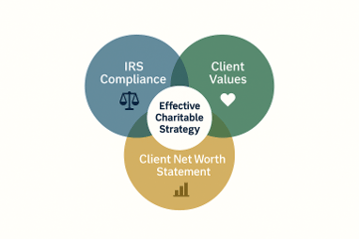
Effective charitable planning begins with balancing three core considerations:
- IRS compliance - ensuring contributions satisfy deduction and reporting requirements
- Donor values - supporting the causes and organizations that matter most to the donor
- Donor financial position - integrating charitable goals into the donor’s broader wealth strategy
When these elements align, charitable giving becomes more than a donation - it becomes a thoughtful and powerful component of a family's overall financial plan.
Four Core Charitable Planning Strategies
While charitable planning strategies can range from simple to highly sophisticated, most planning conversations center around four core approaches: bundling contributions, donating appreciated assets, donor-advised funds, and qualified charitable distributions. These strategies build upon one another and can often be combined for greater efficiency.
1. Bundling Contributions
One of the simplest but most effective charitable planning strategies is bundling, sometimes called "bunching."
This involves grouping multiple years' worth of charitable contributions into a single tax year so that your itemized deductions exceed the standard deduction. This is best used when a single year’s worth of deductions doesn’t already exceed the standard deduction.
For example, in this scenario, we see how a family may achieve a higher total deduction over two years when utilizing bundling. In this hypothetical illustration, utilizing a bundling strategy results in an estimated tax savings of $5,328 based on the assumptions shown. Actual tax benefits will vary based on an individual’s tax situation, deductions, tax rates, and applicable law.
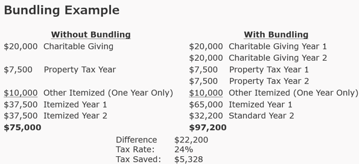
*Illustrative example only. Not representative of any specific client experience. Tax results will vary.
The primary tradeoff here is cash flow. Because future gifts are accelerated into a single year, advance planning is essential.
2. Donating Appreciated Assets
Another often-overlooked strategy is donating appreciated investments, such as stocks, instead of cash.
Depending on individual circumstances and applicable tax law, this approach may provide benefits including:
- The donor may reduce or avoid capital gains tax on the appreciation
- Allow the charity to receive the full market value of the asset
- Generate a charitable deduction in many situations
Imagine donating stock worth $40,000 that was originally purchased for $10,000. If the stock were sold first, taxes could be owed on the $30,000 gain. By donating the shares directly, the donor may avoid those taxes while still supporting a charitable cause.
Whether combined with bundling strategies or not, gifting appreciated assets can significantly enhance overall tax efficiency. Of course, asset donation is subject to IRS charitable deduction limitations and valuation requirements may apply. Not all assets are accepted by all charities.
3. Donor-Advised Funds (DAFs)

For donors seeking flexibility, donor-advised funds (DAFs) can be a powerful planning tool.
A DAF allows you to:
- Claim a tax deduction today
- Invest donated assets for potential growth
- Recommend grants to charities over time
Think of a DAF as an investment account dedicated to charitable giving. A donor may consider contributing assets during a high-income year as part of a broader tax planning strategy, subject to applicable deduction limitations. It is important to note that once assets are given to a DAF, it is a completed gift and cannot be reversed.
DAFs are especially valuable for individuals approaching retirement or experiencing a significant liquidity event who want to pre-fund future charitable giving. Note: assets become irrevocable charitable gifts, investment losses are possible, and administrative fees may apply.
4. Qualified Charitable Distributions (QCDs)
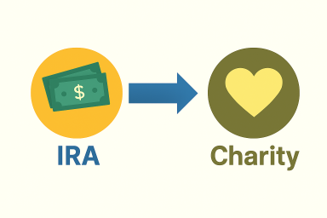
Once an individual reaches age 70½, another planning opportunity becomes available: the Qualified Charitable Distribution (QCD).
QCDs allow individuals to:
- Donate directly from an IRA to a qualified charity (up to $111,000 per taxpayer for 2026)
- Exclude the distribution from taxable income
- Satisfy required minimum distributions (RMDs), when applicable
Because QCDs reduce adjusted gross income rather than creating an itemized deduction, they can produce benefits beyond income tax savings. In some situations, lower AGI can help reduce Medicare premium surcharges and decrease the taxation of Social Security benefits.
For some retirees, QCDs may be among the more tax-efficient charitable giving strategies available, depending on their financial and tax circumstances. However, it’s important to note that QDCs must satisfy IRS eligibility requirements, are not available from all retirement accounts, and improper processing can affect tax treatment.
5. Charitable Trusts
Charitable trusts can be an effective way for families to balance philanthropic objectives with income or wealth transfer goals. There are two primary types of charitable trusts:
- Charitable Remainder Trusts (CRTs) typically provide an income stream to the donor and/or family members for a specified period, with the remaining assets ultimately distributed to a charitable organization.
- Charitable Lead Trusts (CLTs) typically provide an income stream to a charitable organization for a specified period, with the remaining assets ultimately passing to individual beneficiaries, such as children or grandchildren.
These strategies are often considered by individuals who hold highly appreciated assets and would like to diversify their holdings without immediately recognizing capital gains taxes. In the right circumstances, a charitable trust can create a meaningful charitable legacy and may help reduce or defer tax liability in certain circumstances, although outcomes depend on a variety of legal, tax, and financial factors.
While charitable trusts involve legal, administrative, and ongoing maintenance costs, they are often most practical for larger asset values, typically $1 million or more. However, every situation is unique and should be evaluated based on the family's specific financial, tax, estate planning, and charitable objectives.
6. Private Family Foundations
For ultra-high-net-worth individuals (often seen as $30 million or more in assets) private foundations may offer:
- Greater control over charitable decision-making
- Opportunities to establish a multi-generational family legacy
- The ability to support scholarships, grants, and other specialized initiatives
However, foundations also involve greater administrative complexity, regulatory requirements, and ongoing costs than alternatives such as donor-advised funds. As a result, they are often best suited for families with significant charitable intent and substantial wealth, after considering the administrative costs, compliance requirements, and available alternatives.
7. Charitable Giving in Your Estate Plan
For many families, some of the most impactful charitable decisions are made through their estate plan.
Thoughtful planning may include:
- Leaving pre-tax assets, such as traditional IRAs, to charity
- Donating highly illiquid or complex assets
- Coordinating beneficiary designations with broader family and charitable goals
Even relatively small planning decisions can significantly influence how much ultimately reaches heirs versus charitable organizations.
The Bottom Line
Charitable giving is one of the few areas where personal fulfillment and financial strategy align so naturally.
Whether you're giving $1,000 annually or planning a multi-million-dollar philanthropic legacy, thoughtful planning can help:
- Increase your charitable impact
- Improve tax efficiency
- Align giving with long-term financial objectives
- Create a lasting legacy for future generations
The key here is giving with intentionality. Along with asking, "How much should I give?" another question may be "How can I give in the most effective way—for both my family and the causes I care about?"
That's where thoughtful charitable planning can transform generosity into a powerful financial tool.
Footnotes:
This material is provided for informational and educational purposes only and should not be construed as individualized investment, tax, legal, or accounting advice. The charitable planning strategies discussed may not be appropriate for all individuals and are subject to changes in applicable tax laws and regulations. Tax benefits described are dependent on individual circumstances. Readers should consult their tax, legal, and financial advisers before implementing any strategy.
The information in this material is not intended as tax or legal advice. Seven Springs Wealth Group does not provide tax or legal advice. Consult with your tax professional before making any changes to your accounts. All investing involves risk, including the possible loss of principal. Nothing contained herein should be construed as individualized advice and is for informational purposes only. Different types of investments involve varying degrees of risk, and there can be no assurance that any specific investment will be suitable or profitable for a client's investment portfolio. Past performance is no guarantee of future performance. Seven Springs Wealth Group is an investment adviser registered with the US Securities and Exchange Commission (SEC). Registration does not imply any level of skill or training. For a complete discussion of Seven Spring Wealth Group’s services and fees, you should carefully review the firm’s disclosure brochure available at www.adviserinfo.sec.gov